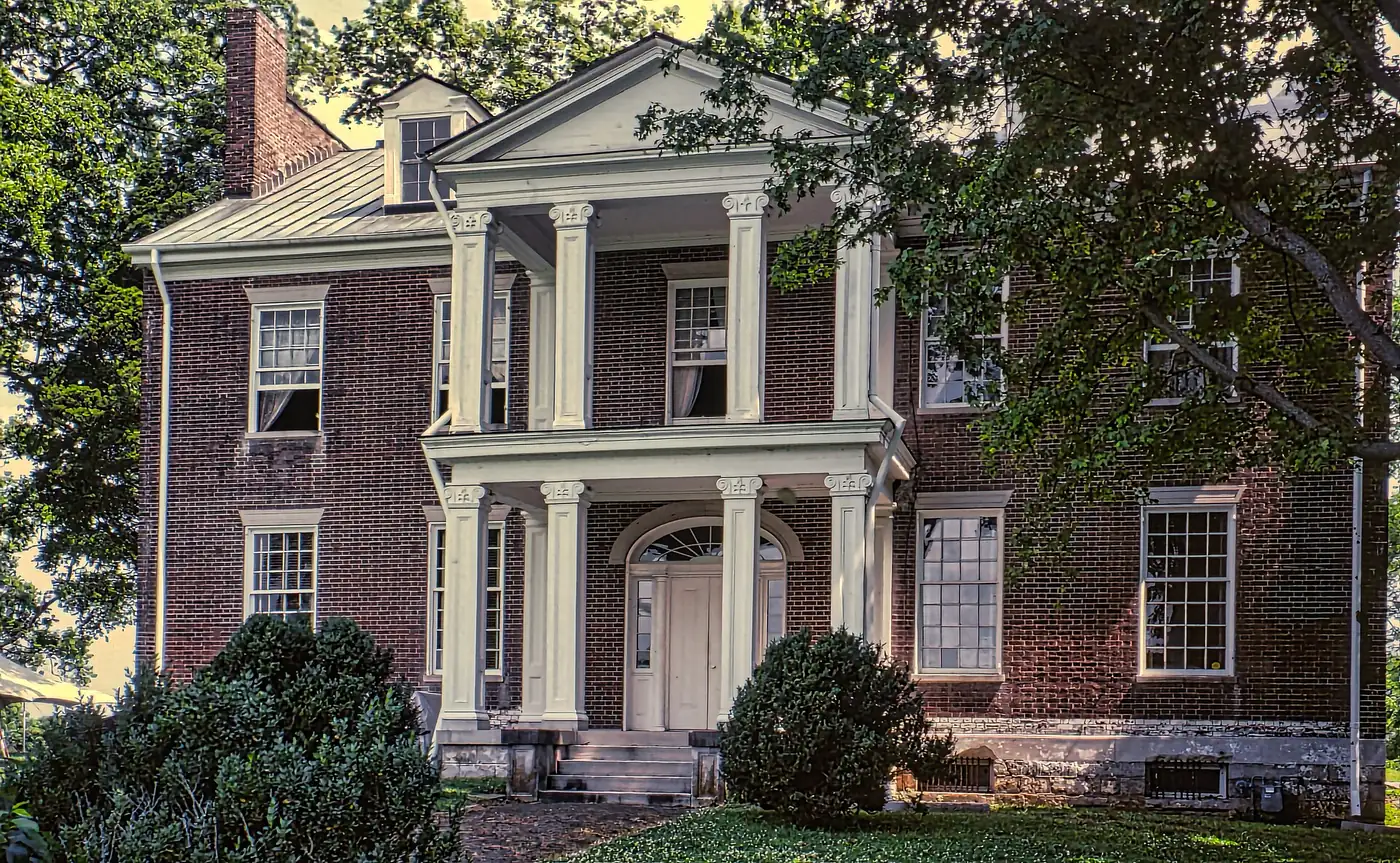
Franklin was created Oct. 26, 1799. The 1864 Battle of Franklin, Carter House, Carnton, the downtown historic district and every National Register listing.
Last checked Oct. 17, 2026. History comes from the City of Franklin and the Tennessee Encyclopedia; National Register listings come from the National Park Service’s National Register data (May 22, 2026, file).
How Franklin began
White settlers were living permanently in the area by 1798, and Ewen Cameron built the first house in Franklin, according to the Tennessee Encyclopedia. The Tennessee General Assembly created Franklin and Williamson County on Oct. 26, 1799. That year Maj. Anthony Sharp sold 640 acres of his military grant to Abram Maury, who laid out the town on 109 acres of it in 1800, inside a bend of the Big Harpeth River.
The town was named for Benjamin Franklin, a close friend of Dr. Hugh Williamson, the member of the Continental Congress for whom the county is named, the city says. Before the Civil War, Williamson County was one of the wealthiest counties in Tennessee, and Franklin was the center of its plantation economy.
Who to call
- Carter House and Carnton (Battle of Franklin Trust): Carter House, 615-791-1861; Carnton, 615-794-0903
- Lotz House: 615-790-7190
- Williamson County Archives and Museum: 615-790-5462
The Battle of Franklin
Union troops occupied Franklin for nearly three years. On Nov. 30, 1864, Confederate Gen. John B. Hood’s army and Union forces fought at Franklin in one of the war’s bloodiest battles, with more than 8,000 casualties; every home and building in town became a hospital, according to the city. It took 120 years for the county’s economy to return to its prewar level. The McGavock Confederate Cemetery near Carnton holds 1,481 Confederates killed at Franklin, the Tennessee Encyclopedia says.
Museums and sites to visit
| Site | Address | Hours as published |
|---|---|---|
| Carter House | 125 W. Fowlkes St. | 9 a.m. to 5 p.m. Monday to Saturday; 10 a.m. to 5 p.m. Sunday; last tour 4 p.m. |
| Carnton | 1345 Eastern Flank Circle | 9 a.m. to 5 p.m. Monday to Saturday; 10 a.m. to 5 p.m. Sunday; last tour 4 p.m. |
| Lotz House | 1111 Columbia Ave. | Book by phone, 615-790-7190 |
| Williamson County Museum | 611 W. Main St. | Free; see the county’s page for hours |
| Fort Granger | Behind Pinkerton Park | City parks, dawn to dark |
Carter House and Carnton are run by the Battle of Franklin Trust, which offers several tours a day. The Lotz House, across the street from the Carter House, was the home and woodworking showroom of Johann Albert Lotz, who took his family across the street to the brick Carter House for safety on the eve of the battle, the Lotz House says. The city also runs Winstead Hill, Carter’s Hill and Eastern Flank Battlefield parks, with a historic parks audio tour.
Historic downtown
The Franklin Historic District, centered on Main Street and Third Avenue, was listed on the National Register on Oct. 5, 1972, and enlarged in 1988 and 2000. Downtown neighborhoods listed as their own districts are Hincheyville (1982), Lewisburg Avenue (1988), Adams Street (2000) and Natchez Street (2004).
Cemeteries
- Franklin City Cemetery, North Margin Street between Third and Fourth avenues, listed 2012.
- Rest Haven Cemetery, North Margin Street between Fourth and Fifth avenues, listed 2012.
- Toussaint L’Overture County Cemetery, Del Rio Pike at Hillsboro Road, listed 1995. The first burials were around 1869, and the cemetery was incorporated in 1884, the Tennessee Encyclopedia says.
- McGavock Confederate Cemetery, near Carnton.
National Register listings in Franklin
The National Park Service file lists these properties with a Franklin location. Year listed in parentheses.
In the city: Franklin Battlefield, a National Historic Landmark since 1960 (1966); Rainey House, 244 First Ave. (1970); St. Paul’s Episcopal Church, 510 W. Main St. (1972); Franklin Historic District (1972); Fort Granger (1973); Carnton (1973); Hiram Masonic Lodge No. 7, South Second Avenue, a National Historic Landmark (1973); Winstead Hill, 4023 Columbia Ave. (1974); Lotz House, 1111 Columbia Ave. (1976); Winstead House, South Margin Street (1979); Cox House, 150 Franklin Road (1980); Hincheyville Historic District (1982); Lewisburg Avenue Historic District (1988); Alpheus Truett House, Franklin Road north of the square (1988); Andrew C. Vaughn House, 501 Murfreesboro Road (1988); Henry H. Mayberry House (1988); Maney-Sidway House (1988); Knights of Pythias Pavilion (1988); John Henry Carothers House, Liberty Pike (1989); Toussaint L’Overture County Cemetery (1995); Dortch Stove Works, 230 N. Franklin Road (1997); McLemore House, 447 11th Ave. N. (1999); Adams Street Historic District (2000); Roper’s Knob Fortifications (2000); Craig-Beasley House, 503 Boyd Mill Ave. (2003); Natchez Street Historic District (2004); Robert Hodge House, 409 Madison Court (2005); Harlinsdale Farm, 239 Franklin Road (2006); Hamilton-Brown House, 845 Old Charlotte Pike (2006); Franklin City Cemetery (2012); Rest Haven Cemetery (2012).
Around Franklin, with Franklin addresses: Harrison House (1975); William S. Campbell House (1975); Glen Echo (1976); Wyatt Hall (1980); Meeting-of-the-Waters (1982); Montpier (1982); Cedarmont (1984); and, all listed in 1988, Boyd Mill Ruins and the William Boyd, John Crafton, Douglass-Reams, Samuel F. Glass, Henry P. Gray, Franklin Hardeman, John Herbert, John Hunter, William W. Johnson, Claiborne Kinnard, Knight-Moran, William Leaton, H.G.W. Mayberry, David McEwen, McGavock-Gaines, Daniel McMahan, Samuel S. Morton, John Motheral, Dr. Hezekiah Oden, Nicholas Tate Perkins, George Pollard, Mordecai Puryear, Y.M. Rizer, John Seward, Thomas Shute, William Steele and Beverly Toon houses, Forest Hills School, Old Town Bridge, Old Town and Trinity United Methodist Church; Boyd-Wilson Farm (1996).
Archaeological sites (addresses restricted): Old Town Archeological Site (1989), Anderson Site (1990), Coats-Hines Archeological Site (2011) and Glass Mounds Discontiguous Archeological District (2015).
Related guides: parks and trails, things to do this month and Christmas parade and tree lighting (Dickens of a Christmas).
Frequently asked questions
When was Franklin, Tennessee founded?
The Tennessee General Assembly created Franklin and Williamson County on Oct. 26, 1799. Abram Maury laid out the town on 109 acres in 1800.
Who is Franklin, Tennessee named after?
Benjamin Franklin, a close friend of Dr. Hugh Williamson, the Continental Congress member for whom Williamson County is named.
When was the Battle of Franklin?
The Battle of Franklin was fought on Nov. 30, 1864, and cost more than 8,000 casualties, according to the City of Franklin.
What are the hours for Carter House and Carnton?
Both are open 9 a.m. to 5 p.m. Monday through Saturday and 10 a.m. to 5 p.m. Sunday, with the last guided tour at 4 p.m., the Battle of Franklin Trust says.
Is the Williamson County Museum free?
Yes. The county museum at 611 W. Main St. is free and open to all, with on-site parking.
Have your say